Thursday, September 20, 2012

Don't Be A Dipstick- Check your oil.


Every car ever built consumes oil.  You heard me right.  Your brand new, Toyota?  Yep.  That shiny Jaguar?  Absolutely.  Your fancy rotary-engined Mazda.  Oh, lord yes. And don't even ask about German cars!

Oil serves a very important function in your engine.  It keeps all of those metal pieces from chewing each other to tiny little metal shavings.  So, it's pretty important that there's enough in there.  I would be willing to bet that if I pulled the dipstick of 10 random cars between oil change intervals, 7-8 of them would be noticeably low and need topping-off.

But how often is this done?  When was the last time you checked your oil?  Have you ever checked it?  Do you even know how?  It used to be, service station attendants would check your oil every time you filled up with gas.  As more gas-stations became self-service and fewer attendants were conducting this valuable maintenance routine, too few people realized the importance.  And unfortunately, as fewer and fewer people checked, cars continued their slow burn of liquid gold (yes, oil is gold and not black.  If it is black, it's time to change it!).

While some newer cars consume decidedly less oil than others, all cars consume some amount of oil.  How much depends on many factors:  the compression ratio (high is more likely to consume more oil), the number of cylinders, the tolerances of the moving parts within the engine, operation conditions and speed, turbochargers (oil used for cooling evaporates and is not reclaimed 100%), fuel contamination due to faulty crankcase ventilation, etc...the list just goes on and on and on.


But, you can help protect your car with one easy routine that only takes minutes and almost no mechanical ability whatsoever:  Check your oil level via the dipstick!

3 dipsticks, top to bottom: 1960s-70s British car; 1990s-era American domestic; and 2000s-era German.
What is a dipstick?  A dipstick is a small stick with a finger loop on one end and a rudimentary gauge on the other.  The gauge end rests in the oil pan of your car, while the loop end rises up a tube into the engine bay of your car for easy access.  Modern oil dipsticks are usually identified by bright coloration, usually yellow or orange.

To check your oil, you will need the following:
- a rag or paper towel

That's it.
To start, grab the ring on the dipstick and pull:


If the car has been running, oil will have splashed up the dipstick.  For an accurate reading, wipe the length of the dipstick off with a rag or paper towel, reinsert into the tube, and pull out again.  Without wiping, hold the dipstick horizontally to read:

In this case, the oil reads just below the "Max" indicator, a properly full oil pan.  If the reading is above MAX, you should not drive the car excessively until it is properly drained to the correct level, as this indicates too much oil and will foul the valves, causing potential damage.  The MIN line, unreadable on the left in this photo, is the danger zone for lack of oil.  You should keep the oil between the indicated levels, and I recommend as close to full as you can without over filling.

It looks like this on other dipsticks:

Sorry for the blurry iPhone picture- low is to the left, full on the right.  The dots indicate level, the rightmost of which represents full.  As you can see, this car is very slightly over filled.
This old British dipstick is very easy to read.  In this case, the level is too low.  Good thing I caught this when I did!


If your car reads low, you simply add oil by removing the oil cap from your engine ("lefty loosey"), and pouring oil in slowly.  Give a slight pour for about 2-3 seconds, check again, add if needed, repeat. 
Loosening the oil cap
Slowly pour oil here, check, and repeat as necessary.  And be careful not to make a big mess.


I recommend checking your oil every few hundred miles.  The easiest way to remember to do this is checking every time you fill your tank with gas.  Also, following this schedule allows you to accomplish this task, start-to-finish, before the pump shuts off, time you would normally spend staring at the pump's numbers going up, up, up.  Just keep a quart of proper oil (check your owner's manual for oil specification) and a rag in the trunk, wrapped together in plastic to prevent leaks, and keep your car running happily for a lot longer than those who never check!

Saturday, September 15, 2012

The Dirt on Cleaning Your Car


The world is a filthy, filthy place.  Between dust, pollen, road dust (mostly brake and tire dust), bird poop, tree sap, acid rain, road salt, snow, ice, and various airborne industrial residues, your poor car endures a lot of grit, grime, and goo in service to you.  The very least you could do in return is give it the spa treatment!

Automatic or "Drive-Thru" Washes:

Automatic car washes are convenient, but those brushes are anything but good for your car.  Every speck of dirt, sand, or gravel that comes off of the car before you went one place- into those brushes.  No  matter how soft they are by design, they become veritable sandpaper by the time they've washed 5-6 cars.  Most of them have probably been in service for hundreds, if not thousands of washes.  Just imagine all of the little scratches they'll incur to your paint.  Especially if you drive a black car.  The Horror:

 "Touchless" or Power Washes:

 What about "touchless" car washes, or the "do it yourself pressure wash"? First off, you're car won't be very clean.  There will almost certainly be a film of dirt still on the car post-wash. While they're slightly better for your paint than the brushes, the high pressure washes are dangerous in their own right, and potentially far more destructive than brush washes when the worst happens.  Imagine this:  You've taken a highway jaunt, and a small piece of gravel has bounced up into your bumper and left a small rock chip, all the way down to the plastic.  Barely noticeable and extremely common.  However, when the high pressure touchless car wash jets warm water directly into the small damaged area at 300psi, the paint around the edges of the chip is blasted back, and what was once an unnoticable chip is now a spot of damage that grows every time you take it through a high pressure wash:

 Handwashing:

There's really only one real way to do it correctly:  handwashing.   Yes, it's a bit more involving than putting your car in neutral, turning off your radio, and closing the window, but consider the benefits:

  • Gentle on paint, tough on dirt.
  • Allows you to experience the design of your car in detail through multiple senses.
  • Allows you to note any damage (ding, scratch, or blemish) before they worsen.
  • Allows you to focus on particularly dirty areas to ensure a very clean car.
What You'll Need:

 (from left to right)
  • Wheel cleaner- all-wheel cleaner is recommended
  • Wheel brush
  • Bucket
  • Car wash liquid (DO NOT use dishsoap!)
  • Microfiber car wash mit or sponge- (do not use household sponges!)
  • Soft, clean cotton terry towel (dry-blade is optional)
  • Tire spray
  • Shop Rag
While many car geeks will tell you you need to buy excessively expensive variants of all of your car wash products, my experience says they're all about the same, more or less.  In my opinion, most any product from Meguiar's or Mothers does the job as well as anything.  Feel free to indulge yourself with expensive "conditioning car shampoo", if you like. It's all about enjoying the experience.

Step 1:  Clean your wheels:

Park your car in the coolest, shadiest location possible.  This will allow you to take your time and not be hurried by the fear of soap spots.  If the car has not been driven today, you can start immediately.  If you've been driving, allow the car to cool or spray the entire car, particularly the wheels, tires, hood, and roof with cool, clean water to cool it.  You may now begin!

 Spray your cooled, dirty wheels with wheel cleaner spray and allow it to soak for a few minutes:
dirty wheel

soak
spray

 Next, take your wet wheel brush and agitate the brake dust from the face of the wheels.  Work methodically around the face of the wheels, and get as far between the spokes as you can.  Once you're convinced they're properly brushed, rinse thoroughly:
Agitating the dirt. 
Rinse
The result:


Step two:  The body:


First, Fill your bucket with soap and water.  Whatever the soap bottle says you need (2 capfuls, etc), I recommend 1.5 times that amount.  The more soap you have, the less the dirt will scratch the finish and the easier it will be swept away when you rinse.  The only detriment is you'll have to rinse more thoroughly.
 

Next, rinse and cool the car one more time.  You'll want to spray it until it is cool to the touch.  Otherwise, the soapy water will bake on and leave soap spots, which means you will need to start over.  Taking your time and making sure the car is cool will take far less time than starting over.


Next, dunk your microfiber sponge int the soapy bucket of water.  Do not wring it out.  All that soap and water will protect your paint.  The drier your sponge, the more damage your finish will endure.  No such thing as too much soapy water!


Starting at the roof, start gently and methodically cleaning the car.  You'll want to hold the sponge against the paint, but do your best not to press into the paint.  Just wisk it across the surface a few times per area. I recommend working in rows or quadrants, so it will be very easy to see where you have cleaned and where you haven't.  Remember, the more thorough and organized your wash is, the less time and energy it takes.

Work your way around the whole car methodically, and don't forget to pay extra attention to the rocker panels (the areas where the side of the body curve underneath the car).  Rinse often.  I recommend rinsing after each section is cleaned (roof- rinse, left side- rinse, etc.) to avoid soap drying and spotting.

 Once done soaping and washing, rinse the entire car very thoroughly.  Pay extra attention to grilles, trunk/hatch seams, rear view mirrors, and vertical shut-lines (such as doors and windows), as they tend to harbor lots of soap bubbles.


Next, dry the car with the soft, clean towel.  Start with your windshield and windows, next the roof and end with the lower panels.  If you have a large car, or a dark colored car, follow the first drying with a second, soft dry towel for best results.


The result!

Now, spray some tire shine on your tires (not too much, or they'll look terrible), and use the rag to wipe the over-spray from your nice, clean wheels.  Great job, you're finished!


Their are lots of opinions on the best way to hand wash a car.  Some would recommend a soap foam gun attachment for the hose (expensive). Others would say use two buckets, one for dirty sponge rinsing and the other for clean water, etc.   Unless your car is especially dirty, I think a single-bucket with a garden sprayer on the end works just fine.


Now go show your car some love!

Monday, December 12, 2011

At the VW dealership for last chance warranty work. Into the great wide open!

Sunday, October 2, 2011

How to Drive Like a Pro: Lesson 1- Using a Blinker, Changing Lanes

All to often, we Americans (particularly those in the midwest) drive like we have received no training or have no competency, have massive entitlement issues, and attempt control even minor situations out of ridiculous pride.  In my next few blog posts, I will address what I see as some very common everyday driving errors that if we all worked hard at correcting, would ensure safer, more efficient, and generally more pleasurable driving experiences for us all.


Lesson 1: Using a Blinker.

Last time I checked, all cars in the United States and in most countries in the world come equipped standard with left and right handed turn indicator lights, or "blinkers" as we call them Stateside.   First implemented in 1903, the blinker is a simple but essential automotive safety device, because it allows other driver and pedestrians to know of directional changes you are planning before you act.  This allows them to prepare, yield if necessary, make course adjustments to avoid accidents or traffic snares.  When you don't use them, you create all of the problems associated with the failure of the previously stated actions occurring.  Don't expect everyone else on the road to anticipate your next move.

Ultimately, there is only one cause of lack of signaling, and that is overt laziness on the part of the vehicle operator.  Should the devices malfunction, it is the responsibility of the operator to indicate using hand signals.  There is no excuse for not signaling, no matter how it is attempted to be justified.  Remember, it takes all of 0.5 seconds to flick the indicator stalk, but it takes much longer to settle your affairs (medical, insurance, body shop, car dealerships, etc) following an accident caused by your causal disregard for important communications between drivers on the road.

Lesson 2: Changing Lanes:


I'll keep this simple:
- use a blinker when changing lanes
-Check all three mirrors and your blind spot before changing lanes.
- Yeild to traffic in front of you when changing lanes from a stopped lane.  If the car in front of you is indicating a lane change, don't try to race them around the stoppage.  You'll probably cause an accident.
- The left lane is for faster traffic, the right for slower and merging traffic.  Act accordingly.
- Yield the farthest left lane after you complete a passing maneuver.  Do not drive in the far left lane when there is no passing undertaken (I'm talking to you, Illinois!)
-Show courtesy when changing lanes, and give others plenty of room as you negotiate traffic around them.

Monday, September 26, 2011

I have been to the Promised Land.

Los Angeles.  Has there ever been a more-hyped town in modern America?  How many countless songs have been written about L.A.?  How many more will be written?  Until last week, I guess I didn't quite get what all the hype was about.   I get it now.

If there's one great thing about Los Angeles, it's the weather.   The air is always pleasantly fair, there is no snow and very little rain, and the sea air is so dry that there is no salt problems.   There are few pot holes, as frost-heave is non existent.  The result: cars are eternal in this Lazarus valley in the west.   I have never seen so many 1980's and older cars in such immaculate, unrestored condition.  Of course, this has created a hub of auto culture the likes of which I have never seen.  Yes, every third car is a Prius, but every fifth car is a pristine, clean, and rust free neo-classic or sports car that would never make it two years in the midwest.

And what cars!  Within 4 hours of landing at Burbank, I saw my first Bugatti Veyron 16.4: 


Within an additional 20 minutes, I saw my second (I didn't photograph the second, as it was old news at this time).  The next day brought the third.  As I was taking the above pictures, some poor schmuck in a brand new Ferrari 458 drove past.   Nobody blinked.  Poor guy. 

I have never seen so many Porsche Panamericas, Aston Martin Vantages (the V12, no less), or Bentley Arnages as I did in a two hour stretch through West Hollywood and Beverly Hills.

Not only are there great cars everywhere, but the average Angelino seems obsessed with keeping their cars absolutely clean.  Not just outside, but all around.  Few dents, dings, and scratches marred common cars, and most everyone seemed to have much better taste in accessories than the common mid westerner, as I didn't see a single fake Buick Ventiport the entire time I was there.
Fake Ventiports...no matter how ugly your Monte Carlo is, these will always make it far, far uglier.  Not taken in L.A.
I also noticed that the vast majority of Angelinos, while obsessed with constantly honking the horn at each other for every single little thing (such as not turning directly into head-on traffic whilst someone of obvious importance is behind), seem to be pretty good drivers overall.  The average following distance is twice what I would consider average in St Louis, blinker usage is way up, and on more than one occasion, a slower-moving car pulled over to allow traffic by before resuming their plodding pace.  I would consider moving west for the latter alone.  They even seem to respect the High Occupancy Vehicle Lane, which would undoubtedly be violated by well over 50% of the drivers in St Louis.

The roads are pretty good, there are very few patches or cracks, and I did not note any potholes.  What's more, Los Angeles seems to be paying their civil engineers to actually do stuff, as most stoplight cycles seem to make sense and merging onto the freeway is aided by a signal called a freeway meter designed to ease congestion as cars come on by metering the number of car entering the freeway at any given time and spacing them accordingly to prevent the jam-ups we encounter here at every major entry in the area.  It makes so much sense!  Why haven't the engineers here figured these things out?

Ramp Meter: Effective device that somehow eludes civil engineers everywhere else.

For all of these reasons and more, it is evident that Los Angeles and the rest of Southern California is an automotive paradise, especially when you break free of the busy cities and see those miles and miles of lonely desert highways.  I actually feel guilty for exposing my beloved car to the harsh mid-western climate in contrast, and may well just mosey west one day myself.

Wednesday, September 7, 2011

Pontiac Aztec: The Most Misunderstood and Wrongfully Slandered Car of Modern Times, and Maybe Even All Time.


So, I'm at a wedding this weekend, when the groom, Dwayne, asks me if it's possible for me to write a blog post that will somehow redeem his Pontiac Aztec.  I chuckled at first, but the more I thought, the more I realized that the Pontiac Aztec was an awful lot like sharks, snakes, and the music of Andrew W.K.  It's quite easy to get the wrong first impression from these things, but once you really get to know them and understand them, you soften a bit.  What was at first a scary animal becomes a very elegant, well-designed, and helpful creature.   What was once a juvenile song about partying 'til you puke suddenly becomes an elegy for forgotten youth and carefree days of the past.  Such is the Pontiac Aztec.

I don't think I've ever read a book about bad cars or seen a "top ten worst cars ever" list without mention of the Aztec.  It has become a target of mass hysteria when it comes to criticism of it's styling, which I admit is not what I'd call ideal.   However, if you can imagine it with slightly less black plastic cladding, a more rounded rear roof line, and a single front end rather than the unique, double-decker front, you have something like this:
BMW X6

Which, in my opinion, is not only uglier, but costs more than twice as much.

But I digress.   Back to the Aztec, it offered V6 power standard, and could be optioned with all-wheel drive and a number of totally xtreme lifestyle accessories, my favorite of which is a tent:

This, friends, is a burly lumberjack of a minivan-based SUV.
New, they came with a back pack built into the back of the seat that could be removed and used, a plethora of optional bike/kayak/snowboard/surfboard racks, and a massively cavernous interior that could hold at least 20 small dogs behind the front seats.  Toss in a powered cooler option, and you've got a rolling party/campground that will seat five very comfortably when you're done fooling around.

Next time someone tells a "Pontiac Aztec=worst car ever" joke, consider the bumblebee, the shark, and defend the lowly creature from more undue harm.   Are there better cars?  Certainly.   Would I drive one?   Maybe if the zombie hoard is here and I need all-wheel-drive and a cavernous interior but decent gas mileage.  But for those who can look past the criticism of the styling and the styling itself, there is a pretty cool hauler here that forgoes convention and offers an interesting package for not much money on the used market.

Tuesday, September 6, 2011

A Touch of Grey? Part 2: Cadillac CTS-V

If I were to rent a DeLorean time machine and travel back to tell myself at 18 years old, that by 30, I really wanted to own a new Cadillac, I would be severely beaten and laughed at by the younger version of myself.   Young punk that he was. Which would cause a massive rift in the space-time continuum and effectively end the world in a paradox.  So I wouldn't do that, but I think you get my point.  Cadillacs were very, very lame for a long time.  Nothing screamed "geezer" like a crest with a wreath and six ducks gently swimming on it.

Who knew that Henry Leland, The Geezer King, would still hold so much sway over his company into the early 2000's, well after his death in 1932.  After selling Cadillac to GM in 1909, he also founded Lincoln.  That's just how geezery he was.
That's not to say that nobody tried to make Cadillac cool again, but GM certainly wasn't having a go at it.   A little known fact is that Tim Allen, of Home Improvement fame, actually owned a company called Tim Allen Design (TAD), which did their best to make grandpa cars appealing to someone, say, in their mid forties.  They only made one car, and gave up.   GM just kept on pumping out those big, soft boats for the population of Florida, until one day, they noticed that old people eventually die.   And dead people don't buy many Cadillacs.
Cadillac Catera


So, in 1997, Cadillac did what any good GM division of the time would do if they needed a new model:  They rebadged an existing car, in this case, the Opel Omega, as the Cadillac Catera.  The result?  They sold a few to the less than 60 crowd, and the cars died before their owners did.  Maybe they were on to something with this idea.
2006 CTS-V


Then came the replacement to the Catera in 2003, the CTS.  Not only was it rear-wheel drive, but it could be purchased with a manual transmission!  Like a BMW or Mercedes, not so much like a Buick or Oldsmobile.  Even more, it could be ordered in CTS-V trim, which got you a 400hp V-8 under the hood.  Now, we're getting somewhere.
Let's see you grandpa's Caddy do this...


In 2007, Cadillac released the new CTS, and it was really, really cool looking.   When they released the CTS-V version in 2008, it was even more awesome.  Now with 556 hp from a supercharged Corvette engine, it was a legitimate world-beater, and was the fastest production sedan in the world at the time of it's release.  GM, for once, didn't rest on its laurels, and released a stunning coupe to accompany the sedan:

Your beloved grandmother wouldn't even know what to do with this.

And, in a totally unexpected move that makes Cadillac officially cool, they release a CTS-V Wagon. Oh no, they didn't!
Just imagine, you're heading to Home Depot to buy some home improvement supplies early on a Saturday morning, and when you get to the strip mall, they've got part of the parking lot roped off and are running SCCA (Sports Car Club of America) Auto-X out there.  And you decide to enter, blow the doors, roof, and wheels off of a bunch of Porsches, Corvettes, and maybe even a BMW M3 or two, return to Home Depot, buy a new toilet and sink for your bathroom, load it in the huge cargo area, and drive it all home in a luxury car which also happens to be sports car and a pickup truck.   And your wife, boss, parents (who also own a geezer Cadillac) and/or kids will have no idea just how much fun you are having, or just how exciting your life now is.  And that, my friends, is why Cadillac is suddenly very, very cool

Monday, August 29, 2011

A Touch of Grey? Part 1: Buick Regal

Am I getting older?  Is that my hair clogging the drain every morning, or is it errant pet hair that mysteriously found it's way into the tub?  Does my back actually hurt from stooping over a seized engine all day?  Is my hairline moving back, or is my cranium getting bigger?

Are Cadillacs and Buicks suddenly cool?

While I may, in fact, be losing my hair and the rest of my youthful vigor, it would seem that GM may finally be getting it.  Cases in point:  The new Buick Regal and the Cadillac CTS.


Just look at the Buick.  That's right, the photo is of a white Buick, apparently the only one made in the last 30 years not parked outside of either an old-folks' home, church, or Cafeteria restaurant.  In all seriousness, Buick used to make exceptionally cool cars.  Names like GNX, Grand National, Grand Sport, Riviera, Skylark, and Wildcat spark memories of muscular, classy, luxurious, fast-yet-comfortable, good-value for the money cars.  Sometime in the mid '70's, Buick decided that as their devout fans from the 40's and 50's aged, they would age with them.  Which worked well from a business perspective, until those devout fans started bumping up against the century mark (Buick named a car after this important event in the history of the company) and began dropping like flies.  As the hearts of these sweet old folks stopped beating, the company also seemed to lose it's pulse.

In some kind act of sympathy, GM spared Buick the reaper's scythe when the global recession hit in 2008, and rather than cut a division with dated styling and even more dated customers, they cut Pontiac.  Sure, Pontiac made it's fair share of cars that were the automotive equivalent of disposable diapers (they tended to sag as they filled with their own crap), they were making recent inroads with interesting, non-redundant models such as the Pontiac Solstice and Holden-based GTO and G8 models.

Having cut some good products to save Buick, GM needed a good Buick, and they needed it fast.  So, they took the European car of the year from the prior year, the Opel Insignia, dressed it in a Buick waterfall grille, named it Regal, and sent it to the auto show circuit.  The results?  Most people in the American market had never seen an Insignia, but they sure wanted the Regal.

Showy without being gaudy, it is a rare example of Americanizing the styling of a car without over-doing the chrome.  The lines are absolutely modern, the roofline is very chic, the fenders bulge just enough to look powerful without being exaggerated, and the wheel options are tasteful, as long as the buyer avoids chrome-plating.


Inside, the materials are a bit monochromatic but handsome nonetheless, with modern design and sporty heated leather bucket seats in place of the more tradition old-fogey velour Buick bench.  Column shift?   What column shift?  This baby has a floor mounted six-speed manual standard.  A Harmon/Kardon sound system and a flat-bottomed steering wheel add credibility for the under-AARP membership crowd.

Paired with the GS' optional turbo 4-cylinder engine with 270 horsepower and 295lb ft of torque, this is genuinely a sporty alternative to, say, a Lexus ES.   Start thinking Acura TSX without the horrific styling, and with a better optional engine, and you pretty much know where this car lies in the marketplace.

More importantly for Buick, however, is that people less than 30 years old will think it's cool.  Not because of some marketing campaign or kitschy wheel and spoiler package.  But because it's genuinely cool.


Sunday, August 21, 2011

Have you ever noticed how when you walk past your car, it looks like the headlights are following you?

Why is it that humans relate more to animals than plants or fungi?  Why is it we always look for faces in rock walls, clouds, or the moon?   Why do we keep seeing Mother Teresa in our pancakes or Jesus in our toast?  What is the incessant need to identify a human analogue in nearly everything?  So well wired into our own brains, that we have developed computers who can also identify one face from another.

Even tiny babies pay close attention to faces from birth.  We search so diligently for faces, we identify them on inanimate objects.  That particular act, as it were, is so common, that it has a name: Pareidolia.  And hardly anywhere in the realm of manufactured goods is this Pareidolia more evident than in automotive design:

For instance, doesn't it appear that this MX-5 is having more fun than it's pilot?


 So natural is this association, you can accessorize the face of your car to look even more like a human.   Your Beetle needs more sultry eyelashes, you say?  There's an app for that.


From the front, this BMW looks like a very tired, yet very surprised vampire.   From the side, it looks like a pregnant cat dragging it's belly around.   But that's besides the point. 

Are you serious?   What does this little Sprite know that we don't?  How is this level of adorableness allowable by law?  How do you not wish there was a little tongue hanging out the side of that grille?

Now that I've planted the seed of thought, I hope that you look a bit differently at the parking lot full of cars or the traffic jammed on the highway, and instead of an inconvenience, see all of the cute, smiling, happy, intimidating, or tough-looking faces, and hopefully, they'll manage to put a smile on your face as well.

Wednesday, August 17, 2011

Behold, the Wonder of Technology!

Do you remember when you had to keep a tire gauge in the glove box?  How about getting pulled over because you had a tail-light burned out?  These are things of the past, my friends.  You see, amongst other things, cars are able to tell us these sorts of things.

For example: Two weeks ago, my right rear tire was losing about 3 lbs of pressure every day, and as it turns out, I had 2 nails in one tire (I drive directly past two construction supply yards on my way to work, one that is located exactly at a very rough railroad crossing, so you can imagine just how many nails may be in the roadway.)  I knew this without some disastrous blowout or completely flat tire because my car told me.  For a week straight, my car told me to fix that tire, but I kept putting air in it every morning rather than patch it.  And my car was relentless about giving me the business until  I quit being lazy/cheap and got it fixed.

Today, my car informed me that a light bulb had burned out.  Not just a lightbulb, but specifically, the right rear brake light.  I didn't have to get a "fix-it" ticket to know this.  And this is all information I get for free, as an average consumer with absolutely no mechanical or electrical work needed. 

If you're like me and not afraid to pop the hood and turn a wrench, you can buy (for an extremely affordable $100 or so) a code reader which will, as easily as plugging a cord into a socket,  tell you not only why your check engine light is on, but will also give you an error code you can use to reference exactly what has gone wrong with your car.  Or you can go to Autozone, and they'll read the code and print it out for free.  Whether your oxygen sensor or mass air-flow sensor has gone bad, or your gas cap is loose, you'll know within minutes for very little outlay.

The concept of a modern day "unreliable" car is unfounded, and the fact that the cars are designed to communicate so well exactly what is wrong puts even more of the blame on negligent owners.  My point is, if your tire pressure light comes on, look into it.  If your "check engine" light illuminates, by all means, check your engine or pay someone to check it for you.  Your car is trying it's hardest to be reliable and dependable.

Friday, August 12, 2011

My 10 Favorite Cars #1: Alfa Romeo GTV


Man, just look at it.   This is, without a doubt, the greatest car of all time.   Definitely the prettiest.    Another masterpiece by Giorgetto Giugiaro, this little muscle car was and is an absolute, definitive example of what every car should be.   Note the amazing shape, which has aged incredibly well, and the tasteful restraint in chrome and slapdashery.

GTV stands for "Gran Turismo Veloce", or "Fast Touring Car", which means a sporting car designed for comfort on long trips, a car meant to cross continents at high speed and allow the driver and passenger to arrive refreshed and relaxed.  Wait, look at the picture again.  Heartbreakingly gorgeous, isn't it?   


Inside, you get a well-appointed cabin, with a wonderfully oversized Nardi wood-rimmed steering wheel and wood trim everywhere, as well as sporty bucket seats and a shifter mounted high and to the middle of the console.  Check out all those auxiliary gauges!

Even though these wonderful little cars established a reputation for being "fragile", it is well known that when a classic Alfa GTV is running, it is pure bliss.


Observe that beautiful inline-four.  This little mill made 135hp, and was more than enough to scoot the 2170lb car along with little effort.  The GTV had a five-speed manual, one more gear than was common in sporting cars of its era, and 4-wheel disc brakes. In its day, this little hot rod could run with Ferrari and Porsche on racetracks and twisty roads, and was livable for everyday driving.

A good GTV can be had from $7000- $15,000, meaning I am quite likely to acquire one in my lifetime.   Which means my friends and family will never hear the end of it!  On a related note, last night I dreamed I bought one...


Tuesday, August 9, 2011

My 10 favorite Cars #2: Volkswagen GTI

Man, they just don't get a whole lot better than this one.  When VW engineers worked after-hours on a car that wasn't ever originally planned for production, the result was so good that even the suits could see absolutely no reason not to produce the world's first "pocket rocket", and a motoring icon was born.

The body  of the Mk1 was designed by legendary Giorgetto Giugiaro, the shape is very much the same as more pedestrian Golf models, but through subtle bits of flair, such as the red around the grille and the black around the rear window, somehow achieves a more distinctive and special quality.  As always, the Giugiaro design is a magnificent combnation of style, engineering, and practicality. 

GTI stands for "Grand Touring Injection", and as you'd expect, it came standard with fuel injection.    It had 110hp, and weighed under 1,900 pounds, and could hit 60mph in under 9 seconds, which was quite fast in the emission-choked 1970's.  As important, it featured four-wheel independent suspension with quite firm damping but soft enough springing to make it incredibly agile, but also quite comfortable.  And even more importantly, it was affordable.  The GTI gained a cult following who appreciated the above characteristics, as well as the durability and reliability over other sporting cars from Europe at the time.

Over the years, the GTI got gradually larger, heavier, and relatively slower, but maintained a reputation as a motoring icon.  It wasn't until the MkV model (2006-2009 in the U.S) that the GTI got it's true swagger back.  They even remembered to put a red stripe around the grille!


In fact, I like the GTI so much, I own one,  and could not be more happy with it.

Sunday, August 7, 2011

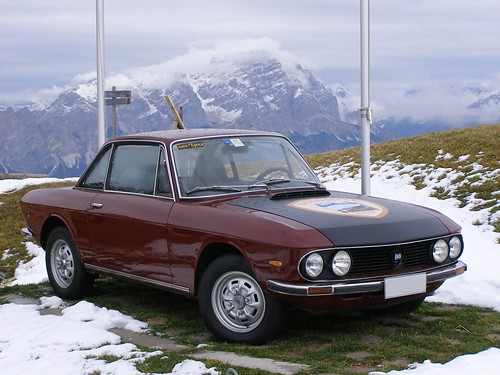
My 10 Favorite Cars #3: Lancia Fulvia HF


Oh man, is this thing sweet.  Just look at those compact dimensions, crisp lines, and aggressive stance.  This little hotted up coupe was a serious race winner in it's day, and has become highly sought after, truly a legendary car.  I could insert all kinds of cliche hyperbole about Italian cars and brio and soul, but I'll refrain.  

What Lancia hath wrought here is a sweet little front-drive razor that looks as good as it goes.  As with nearly all Italian cars of it's day, the 1.6 HF has a high-revving twin cam engine (115 hp).  What it also has is 5 forward gears and plenty of negative suspension camber (wheel tilted in at the top for better handling), and many lightweight  aluminum and plexiglass for better everything.

Man, I would love to own this one.  I'd love to drive it all day, on a twisty, hilly road.  I'd love to sit in the garage and just look at it.